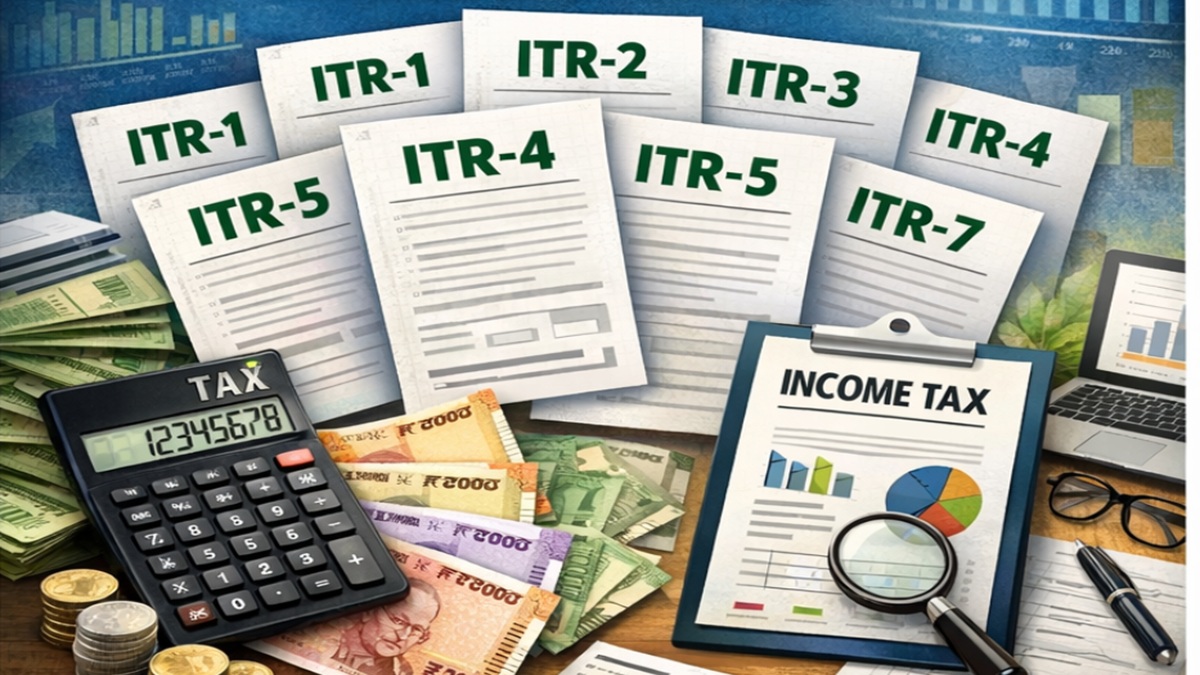

The last date for filing ITR for assessment year 2026-27 is July 31, including for salaried and pensioners. Due to changes in ITR form this year it is imperative to select the correct form, otherwise penalty may apply.
ITR Forms 2026:The last date for filing income tax return i.e. ITR for the academic year 2026-27 is July 31 (ITR Filing 2026). It applies to salaried employees, pensioners and other taxpayers who are not required to be audited. This time the income details have to be given between 1 April 2025 to 31 March 2026. The tax department has made some changes in the ITR form this year. Therefore, before filing the return, it is necessary to select the appropriate ITR form according to your income and the appropriate assessment year. Penalty may be imposed in case of selection of inappropriate or wrong form.
Who is ITR-1 for?
ITR-1 i.e. Sahaj form is for people who are up to 50 years of age. It includes other income like salary, pension, interest and dividends. Taxpayers with long-term capital gains up to Rs 1.25 lakh can also fill this form. This year, the facility of giving information about two houses has been added in this form.
Who is ITR-2 for?
ITR-2 is for Individuals and Hindu Undivided Families (HUFs) who are not eligible for ITR-1. It is not for people whose income is from business or profits and gains of business. This form is mainly used by company directors and people holding unlisted equity shares. A column for Section 89A relief has been added in this form.
Who is ITR-3 for?
ITR-3 is for individuals and HUFs whose income is from salary, pension, house property, business, occupation, capital gains and other sources. This form is for taxpayers who are not eligible for ITR-1, ITR-2, or ITR-4 especially those who have income from business or profession. A new column has been added in this form to give information about foreign assets or retirement income.
Who is ITR-4 for?
ITR-4 or Sugam Form is for Individuals, HUFs and Resident Firms which are not LLPs and whose estimated business income falls under section 44AD, 44ADA, or 44AE. Income from salary, pension, house rent, interest and dividends can also be included. Agricultural income up to Rs 5000 and capital gains up to Rs 1.25 lakh under section 112A can also be included in this form. This form also allows reporting of details of two houses and unrealized rent. The column related to section 89A has also been removed from this form.