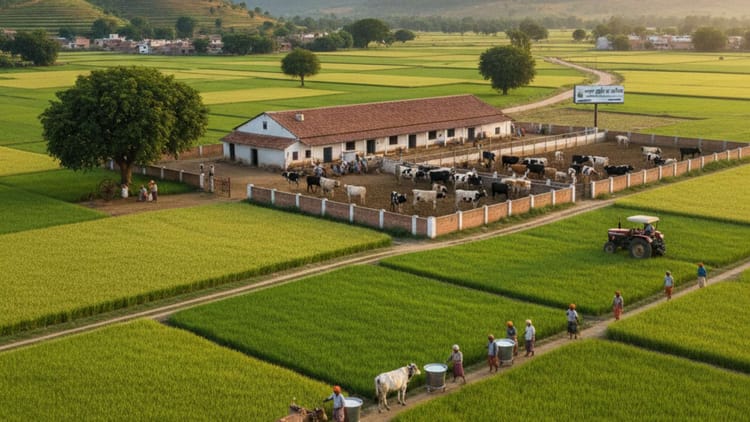
Agriculture in India is not just an economic activity but a way of life and a sensitive sector for the domestic economy. Activities related to agriculture and animal husbandry are the backbone of the country’s rural economy, which provides employment to more than 70 crore people. While agriculture in developed economies is highly mechanized and corporate based, in India it is a question of survival and livelihood.
More than 90 percent of the global food trade is controlled by five multinational companies, which have historically used aggressive pricing strategies. If India gives exemption in agricultural import duty to these companies of developed countries which give huge subsidies to their farmers, then there can be a flood of cheap grains and products in the country. This will have a serious impact on the income and livelihood of Indian farmers.
Developed countries want more markets
India is largely self-sufficient in grain production, while agriculture is a major trading industry for countries like the US, Australia and the European Union. America and other developed countries consider India an attractive market for their export expansion due to large-scale mechanized farming and heavy government subsidies. According to a report, America’s agricultural exports in 2024 will be $176 billion, which is about 10 percent of its total merchandise exports.
Also read:- After Europe, agreement with America: These sectors including employment will get a boost, how much will India’s economic picture change?
Therefore, agriculture is a sensitive sector.
More than 50 percent of the country’s population is dependent on agriculture. Therefore, India considers the entire agriculture sector as sensitive. Import duties, particularly on staple crops, milk and key agricultural products, are critical to rural livelihoods.
Protection is provided by higher fees
India’s agricultural sector is currently protected by medium to high tariffs or import duties and regulations to protect domestic farmers from unfair competition. Opening up a region means reducing import restrictions and tariffs. India imposes duties ranging from zero to 150 percent to protect the agricultural sector. The US also imposes high tariffs on some agricultural products, such as 350 percent on tobacco. The US also imposes complex non-ad valorem (NAV) duties, making imports costlier, experts say. This fact is often ignored in business discussions.
India’s agricultural exports
India is the world’s second largest agricultural producer in terms of value, but its share in global agricultural exports is only 2.2 percent, which was 1.1 percent in 2000. India’s total agricultural exports increased to more than $51 billion in the financial year 2024-25, from $45.7 billion in 2023-24. Of this, about five billion dollars was exported to America.
Also read:- Price of deal with America: India will reduce oil purchases from Russia, is the country’s energy policy changing; Understand its meaning?
India’s target
India’s total exports in 2024-25 stood at $437 billion. India has set a target of taking the combined exports of agriculture, marine products and food-beverages to $100 billion in the next four years. Major export products include tea, coffee, rice, some cereals, spices, cashew nuts, oil cakes, oilseeds, fruits and vegetables.
WTO rules and India
India’s agricultural tariffs do not violate World Trade Organization (WTO) commitments. The rules allow member countries to protect sensitive areas related to food security and rural employment, which are of critical importance to India.
US agricultural export subsidies
US agricultural exports to India could be $1.6 billion in 2024. Major exports include shelled almonds ($868 million), pistachios ($121 million), apples ($21 million) and ethanol/ethyl alcohol ($266 million). According to trade experts, America gives huge subsidies to its agricultural sector and in the last few years it has been more than 50 percent of the production value. America gives 82 percent subsidy on rice, 61 percent subsidy on canola, 66 percent subsidy on sugar, 74 percent subsidy on cotton, 141 percent subsidy on mohair and 215 percent subsidy on wool.