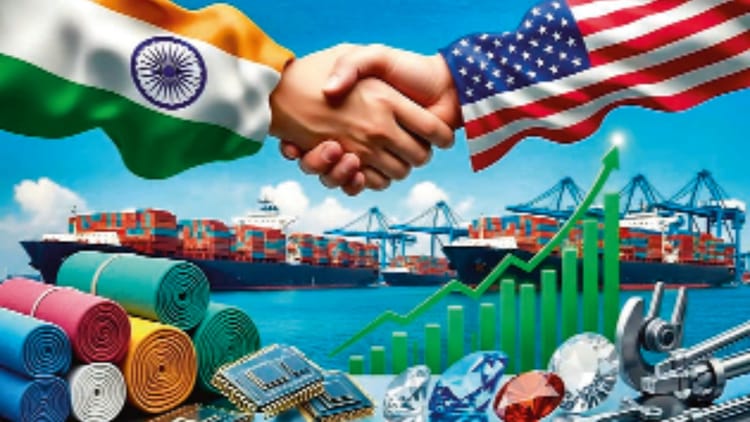
India and America have announced a trade agreement after a long wait. It is expected that this will improve business relations because America still remains India’s largest export market. Experts and brokerage reports say that under the agreement, the US has reduced the reciprocal tariff on Indian goods to 18 percent as compared to the earlier announced rate of 25 percent. Apart from this, penalty tariff of 25 percent has also been withdrawn. Overall the tariff burden which was 50 percent has now reduced to 18 percent. The report of Motilal Financial Limited has said that this agreement will benefit the Indian market and economy in many ways. From the equity market point of view, India’s position seems to be getting strengthened due to the agreements and the recent India-EU Free Trade Agreement. This is expected to support export growth, mitigate the ongoing decline of the rupee against the dollar, attract foreign institutional investors (FIIs) and help stabilize the currency in the medium term.
Moody’s report says that this will boost India’s exports. In the first 11 months of 2025, about 21 percent of India’s total merchandise exports went to America. Additionally, lower duty rates will also prove to be positive for labour-intensive sectors like gems and jewellery, textiles and apparel. Moody’s also warned that if India completely moves away from Russian oil and becomes dependent on other sources, it could further tighten oil supplies and increase prices. Due to this, there will be a danger of increasing pressure on inflation.
India-US trade agreement improves trade relations between the two countries
According to the report of Bajaj Broking, India-US trade agreement will improve the business relations between the two countries. However, its complete information is yet to come. Sectors expected to benefit the most include textiles and garments, gems and jewellery, engineering goods, chemicals, leather and footwear. The agreement may also enhance earnings visibility for the export-dependent agriculture and manufacturing segments. It can also help in short-term recovery in IT services and pharmaceuticals. However, there has been no change in the tariffs imposed under Section 232 on sectors like automobile, steel and aluminium.
Textile and Apparel
According to the report, the textile and apparel sector is highly dependent on the US market, with low tariffs on home textiles, made-ups and clothing improving India’s landed-price competitiveness against exporters from Bangladesh, Vietnam and China. This is expected to lead to more orders, full capacity utilization and increased margins. Given the low margins this sector is labor incentivized, even modest tariff cuts could have a significant impact on U.S. retailers’ sourcing decisions.
Auto Accessories
Indian auto component manufacturers export precision components like forgings, castings, axles, tires etc. to US OEMs and tier-1 suppliers. Lower tariffs increase price competition against suppliers in Mexico and China, which could increase sourcing from India.
pharmaceuticals
The agreement is positive for the pharmaceutical sector, as the US remains the largest market for Indian generics and APIs. Lower tariffs improve price competition against China and other suppliers, support margins in a highly price-sensitive market, and encourage sourcing from India amid ongoing supply chain diversification.
chemicals
Exporters of specialty chemicals, agrochemicals and fluorochemicals with high market demand in the US will benefit from improved trade economics and continued diversification away from China. Tariff relief could lead to better prices, higher volumes and stronger customer relationships.