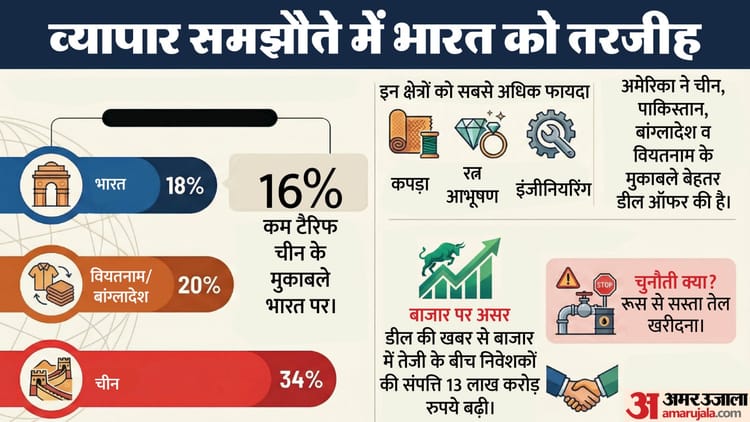
India has scored a major strategic victory on the global trade front, overtaking its Asian rivals. Following high-level talks between President Donald Trump and Prime Minister Narendra Modi on Monday, the US has reduced the import duty on Indian goods from 25% to 18%. Additionally, the US administration has also said that if India stops buying oil from Russia, then the additional 25 percent tariff imposed due to this will not be imposed. This decision has given a direct advantage to Indian exporters in terms of price of products compared to China, Vietnam and Pakistan and Bangladesh.
However, there are some challenges with this deal. For example, in exchange for this deal, India may have to make major changes in its energy security policy, which includes stopping the purchase of Russian oil. India’s decisive advantage over China and its neighbors: This new tariff structure has changed the equation of the export market of South and South-East Asia. Till now Bangladesh and Vietnam were giving tough competition to India in textile and manufacturing, but now Indian goods will be cheaper in the American market.
US tariffs on India and neighbors
• India: 18% (new tariff)
• Indonesia: 19%
• Pakistan: 19%
• Bangladesh: 20%
• Vietnam: 20%
• China: 34%
The imposition of only 18% duty on India as against 34% against China ensures that American companies will now prefer New Delhi over Beijing for supply chains.
What is the ‘deal’ price?
Even though this agreement is a lifeline for Indian exports, the conditions attached to it can be a litmus test for India’s foreign policy. President Trump claimed on social media that PM Modi has agreed to ‘stop buying Russian oil’ and buy more oil from America. A White House official also confirmed this and made it clear that the condition is not just to reduce oil purchases but to ‘stop it completely’. Trump argues that this will help end the Russia-Ukraine war.
What impact did the agreement have on the market?
As soon as the news of this agreement came, a historic rise was seen in the Indian stock market. Sensex jumped 3,500 points and Nifty gained nearly 5%. This single news increased investors’ wealth by Rs 13 lakh crore. The market is considering this as a golden opportunity for the Indian manufacturing and IT sector.
What is Trump expecting from India?
This agreement is not one-sided. President Trump said that India will also move towards reducing its tariffs and non-tariff barriers on American goods to ‘zero’. It has been implemented under the principle of mutual cooperation.
The trade agreement between India and America is a ‘game changer’ for our country’s economy, especially for textiles, gems and engineering goods. The tariff difference of 2% to 16% compared to China and Vietnam will help in making India a ‘Global Manufacturing Hub’. However, what effect the shift from cheap supply of Russian oil to American oil will have on India’s import bill and inflation remains to be seen in the coming months.