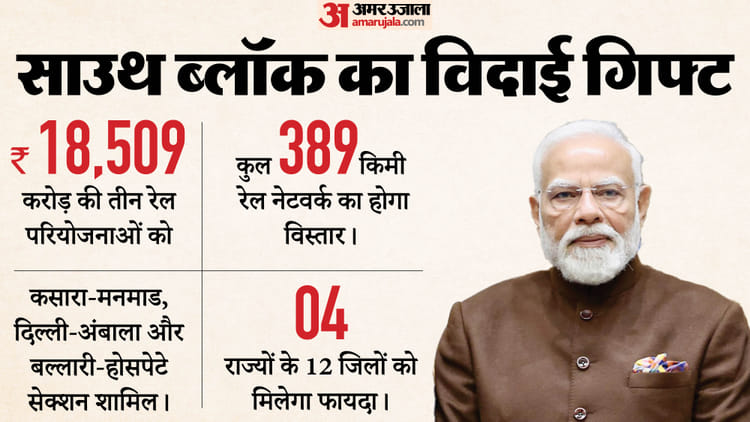
The Union Cabinet Committee on Economic Affairs (CCEA) has approved three important multi-tracking projects of the Railway Ministry. Their total cost is approximately Rs 18,509 crore. The projects which were approved in the meeting chaired by Prime Minister Narendra Modi.
These include these lines
- Kasara-Manmad 3rd and 4th line,
- Delhi-Ambala third and fourth lines,
- Ballari-Hospete 3rd and 4th Line
What is the purpose of the projects?
According to the government, these projects will significantly increase the line capacity of the Railways, which will facilitate traffic, increase operational efficiency and improve the reliability of services. Multi-tracking will help reduce congestion and make operations more streamlined.
These projects have been prepared under the PM-Gati Shakti National Master Plan, which aims to strengthen multi-modal connectivity and logistics efficiency. This will ensure seamless connectivity for movement of people, goods and services.
Which states will the three projects cover?
- The three projects will cover 12 districts of Delhi, Haryana, Maharashtra and Karnataka and will add about 389 kilometers to the Indian Railways network. This will provide better rail connectivity to about 3,902 villages, whose total population is about 97 lakh.
- The government says that these projects will improve access to many major tourist destinations like Trimbakeshwar Jyotirling, Hampi (UNESCO World Heritage Site), Ballari Fort, Tungabhadra Dam and other religious and historical places.
- Also, these routes are important for transportation of major goods like coal, steel, iron ore, cement, food grains, fertilizers, containers and petroleum products. The capacity addition is expected to add an additional 96 million tonnes of freight per annum.
What benefits will you get?
According to the Railway Ministry, these projects will reduce logistics costs, save about 22 crore liters of oil imports and reduce 111 crore kg of CO₂ emissions, which is equivalent to planting about four crore trees. The government believes that these projects will also promote regional development, employment and self-reliance.