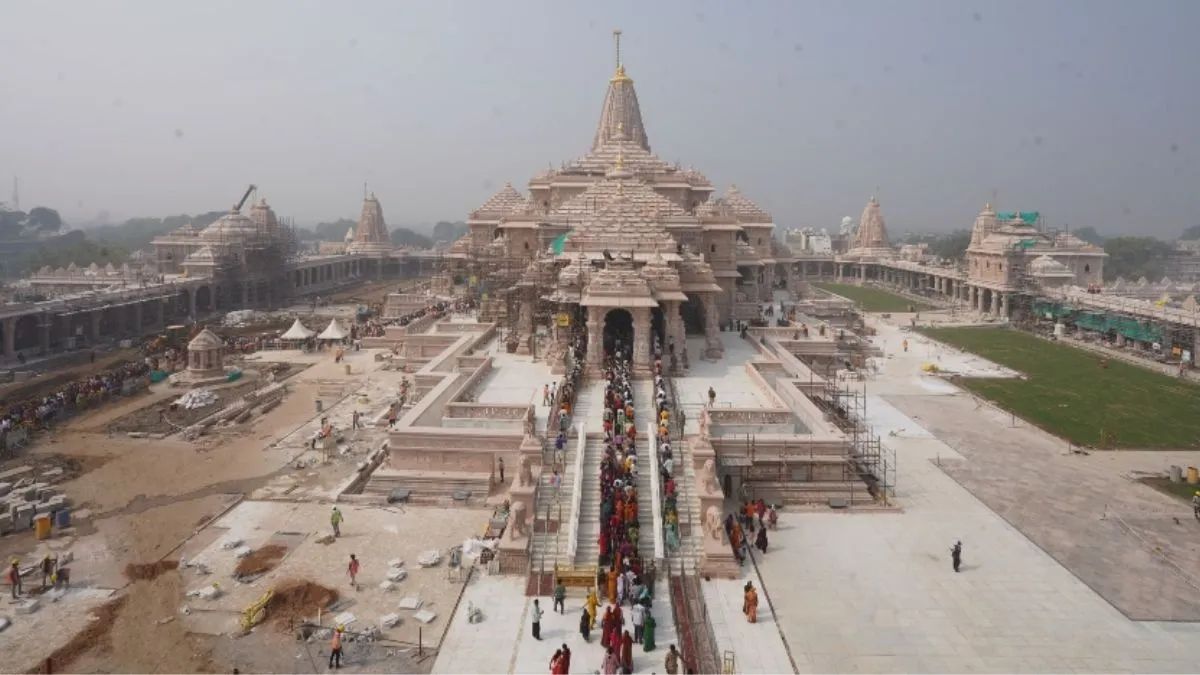


Ayodhya Ram Mandir Trust’s important meeting today will discuss several important issues including resignation of Champat Rai and Anil Mishra, SIT report on donation theft case, audit and appointment of new general secretary.
Ayodhya Ram Mandir Trust Meeting: Sri Ram Janmabhoomi Tirtha Kshetra Trust is organizing an important meeting on Monday i.e. today regarding the theft of Ram Janmabhoomi donation. The meeting will discuss the interim report of the SIT on the donation theft case, the audit report for the financial year 2025-26 and other financial aspects as well as the resignation of the trust’s general secretary Champat Rai and trustee Anil Mishra.
In such a situation, everyone wants to know that Champat Rai and Anil Mishra have resigned, now what action will be taken. However, the formation document of the trust itself provides detailed provisions for the removal and succession of the trustee. Under what circumstances a trustee may resign with immediate effect. This includes resignation by giving one month’s prior notice.
However, if the Board of Trustees removes a trustee from office for acting against the interests of the Trust, it may do so by a resolution passed by a two-thirds majority. Before doing so, a show-cause notice stating the allegations shall be issued and the trustee shall be given an opportunity to reply and be heard.
Future management arrangements in the temple will be discussed
The meeting of the trust to be held on Monday is considered important. Because, it will not only consider the resignation of Champat Rai and Anil Mishra, but also the future management arrangements in the temple. This is also important. Because, Champat Rai is the General Secretary of the Trust, and all the arrangements and operations were run under his direction.
In such a situation, it has become an unresolved issue as to who will be appointed in his place if he steps down. As per the trust deed, the board of trustees consists of 11 members. Who has the right to vote on the proposal. The eleventh member is Mahant Dinendra Das of the Nirmohi Akhara, who has been inducted into the trust as a representative of the Nirmohi Akhara by order of the Supreme Court.
Who are the 10 members of the trust?
Of the 10 members, the first trustee is former Attorney General and senior Supreme Court advocate K. Parasaran, who is a founding trustee and a lifetime trustee.
Trust President Mahant Nritya Gopal Das, Jagatguru Shankaracharya Swami Vasudevananda Saraswati, Madhavacharya Swami Vishwa Prasannatirtha, Parmananda Ji Maharaj, Trust Treasurer Swami Govind Dev Giri Ji Maharaj, Vimalendra Mohan Pratap Mishra, Resigned Dr. Anil Mishra, resigned general secretary Champat Rai, and Krishna Mohan, who replaced Kameshwar Choupal, are also included.
Trustee should belong to scheduled caste.
According to the trust rules, a trustee must belong to a scheduled caste. In addition to the 11 trustees, a senior official from the Central and Uttar Pradesh governments is an ex-officio trustee, and the District Magistrate of Ayodhya is also an ex-officio trustee. Nripendra Mishra, chairman of the Ram Mandir Nirman Samiti, is also a member of the trust.
But in this the Board of Trustees and Mahant Dinendra Das of Nirmohi Akhara together with the right to vote are only 11 people. Their majority in the meeting will decide what to do or not to do. Two members who resigned will not attend. The Trust Deed states that a quorum for any meeting is complete only when 50% of the members of the Board of Trustees with voting rights are present.
Eight employees, who were responsible for counting donations, have now been arrested in the Ram temple donation theft case. But the question is, do the trustees of Shree Ram Janmabhoomi Tirtha Kshetra Trust also bear any responsibility? SR Singh, a retired judge of the Allahabad High Court, says the case is twofold: theft and negligence of fiduciary duties.
According to the law, only those who steal will be punished. Those responsible for negligence may be removed from office, and this applies to ex-officio members, whether or not they have voting rights. Justice Singh said there should be a thorough investigation to determine whether the trustees were involved. If collusion is proven, they will be held equally legally responsible for the theft.