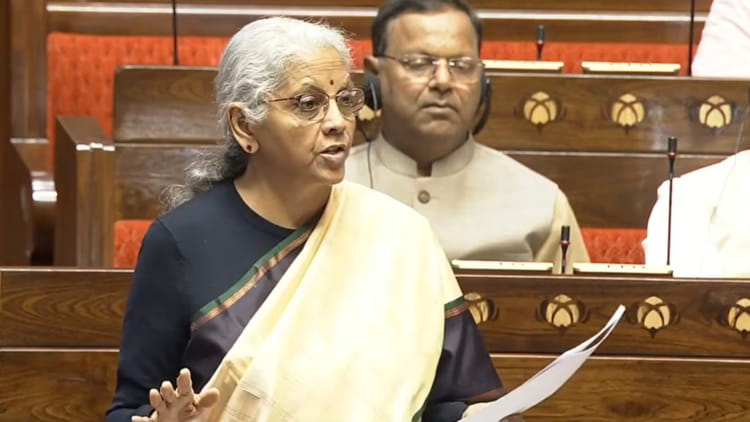
From the global platform of the Munich Security Conference, India has given a strong message of its seriousness and self-reliance in the fight against climate change. Union Finance Minister Nirmala Sitharaman on Saturday gave a clear message that India is not waiting for external financing for climate action. He said that in the last six years, India has increased its expenditure in this direction to 5.6 percent of the Gross Domestic Product (GDP), which is a proof of the country’s commitment.
Huge surge in self-reliance and investment
Participating in a panel discussion, the Finance Minister put forward India’s changing strategy through data. “Six years ago, we were spending about 3.7 percent of our GDP on climate action. Today, this figure has increased to around 5.6 percent,” he said.
Sitharaman emphasized that India itself has invested. “We are not waiting for money or technology to come from somewhere else, although they should,” he said, pointing to developed countries. This statement of the Finance Minister has come at a time when the Global South is continuously raising the issue of delay in climate financing. Giving details of India’s progress in renewable energy, the Finance Minister said that India has achieved two-thirds of its ‘nationally determined commitments’ in the renewable energy sector, four years ahead of the target date.
Talking about the future roadmap, he said that carbon capture strategies have been funded in the Union Budget 2026-27. Its objective is to implement these strategies in the entire country and incentives are also being given for this.
Countries that contribute less to pollution are justified in paying less for climate action.
Sitharaman raised an important policy issue regarding the cost of climate action. He argued that countries that contributed less to pollution should pay less for climate action. He warned that focusing only on emissions controls is not enough. “We also have to focus on flexibility and adaptation. Otherwise, we will have to sacrifice a lot,” he said. The Finance Minister clarified that it cannot be that low-emitting countries are also asked to pay equally; This requires differentiated treatment.
This statement of the Finance Minister is an indication that India is considering climate change not just as an issue but as an economic necessity. A major investment of 5.6% of GDP and inclusion of technologies like carbon capture in the Budget (2026-27) proves that India is now giving priority to concrete action and not just promises on the global stage.