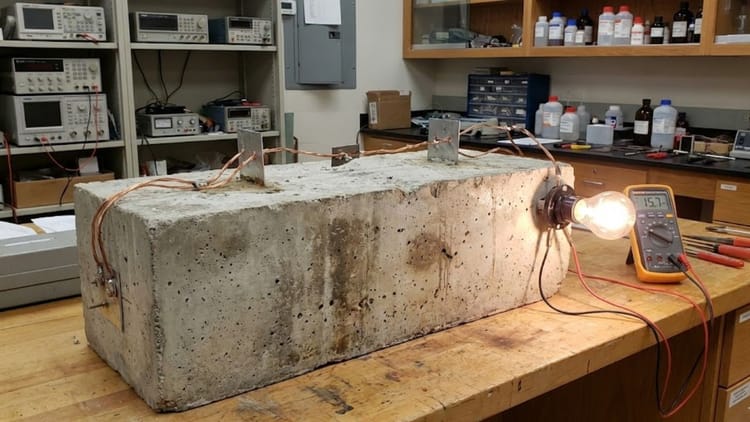
Till now the use of concrete was limited only to making buildings, roads and bridges, but scientists have given it a new form to store energy. Scientists at MIT (Massachusetts Institute of Technology) have prepared a special electron-conducting carbon concrete, which can store energy like a power bank. This concrete could in the future even turn walls, sidewalks and bridges into giant batteries that store electricity.
How does this special concrete work?
This concrete is made by mixing cement, water, very fine carbon black and electrolytes. It is being called ec3. A nano-level network is formed inside it, through which the flow of electricity is possible. Due to this network, this concrete can store energy and also release it when needed.
Sea water can also work
During research, scientists found that many types of electrolytes can be used in EC3. This also includes sea water, making this technology very useful for projects like marine areas and offshore wind farms.
Can generate one day’s electricity
The best results have been obtained with the use of organic electrolytes. One cubic meter of concrete prepared with this technique, a volume approximately the size of a refrigerator, can store more than 2 kilowatt-hours of energy. This is enough to run a fridge for a whole day.
battery safe option
While traditional batteries have a higher energy capacity, ec3 can be incorporated directly into buildings and can last for the lifetime of the entire structure. Rare or dangerous materials are not used in it, which makes it environmentally safe.
Roads will charge electric vehicles
The MIT team is working on taking this technology to parking spaces, roads and homes. In the future, roads may be built that charge electric vehicles, and homes that can function completely off the grid.
Inspired by Roman technology
Researchers say that just as ancient Roman buildings still stand strong today, by combining modern nano-science with the same thinking, the foundation of a new architectural revolution can be laid. This concrete will not only support the buildings, but will also make them a source of energy.