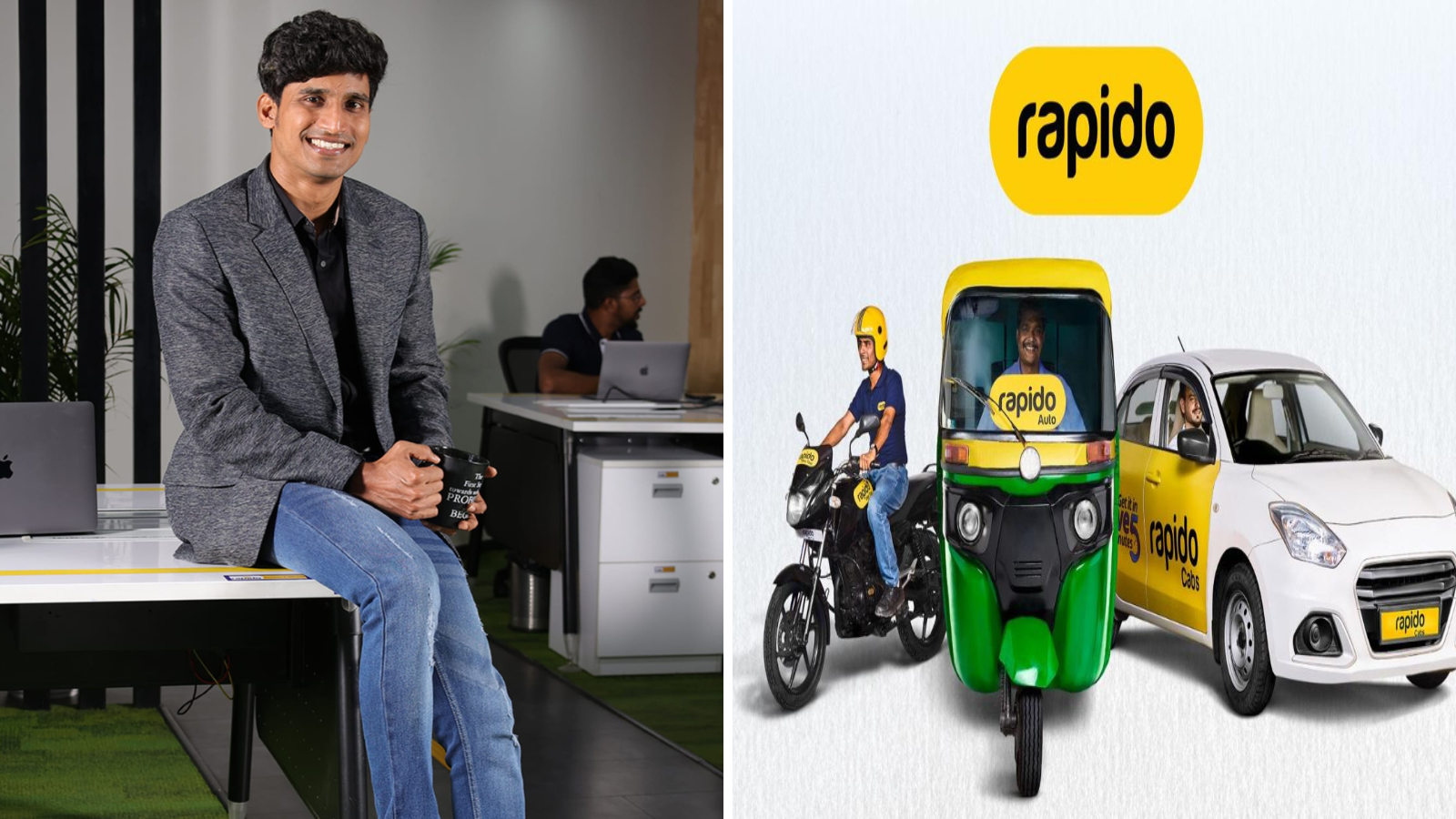
Rapido Co Founder Pavan Guntupalli Interview: The use of app based services for taxi, auto and bike has increased rapidly. However, many such challenges are being seen in this sector, which are definitely not good news. On one hand, complaints from riders are increasing, on the other hand, drivers also do not seem satisfied. In such a situation, we have talked in detail about what Rapido co-founder Pawan Guntupalli is doing to keep cab aggregator customers and drivers happy and you can also know through questions and answers.
Question: Driver retention has become a big issue as drivers recently went on strike saying that companies are making profits while they are being pushed into poverty. What would be your different strategy to counter this perception?
answer: Many people working at Rapido did not participate in the strike. There was no impact on our operations. A big reason for this is that Rapido started a new model two years ago, which we call the SaaS model. The main thing about this model is that the commission in it is absolutely zero. This was the biggest complaint of the drivers. We call our drivers ‘Captains’. What used to happen earlier was that whatever fare the customer paid, the platform would keep about 20–25% of it and the captain would get the rest. There were two problems with this. First, lack of transparency and trust. Secondly, the earnings of the captains, who worked 12–14 hours a day, were reduced by at least 25–30 per cent, making it difficult for them to survive. Therefore Rapido completely changed the model.
We came up with a SaaS model, in which Rapido just delivers the customer’s lead to the driver and the payment goes directly to the captain. The platform does not retain even a single rupee. For this reason, many drivers who were previously unable to come online due to other platforms, are with Rapido today. If you see now, in Delhi city alone we are doing around 8 lakh rides every day. In comparison, Delhi Metro carries around 65 to 70 lakh people every day. In this way, Rapido covers more than 10 percent of the total journey in Delhi.
Question: The biggest complaint by drivers is frequent cancellation of rides. Many drivers themselves force the passenger to cancel and the penalty is imposed on the passenger. Can there be a fair arrangement?
answer: The challenge is to understand the pickup‑drop location correctly. Many captains are not able to read the address written in English properly or cannot understand the address. For this, we have started two new things – one, voice‑based order information, that is, the app itself will tell in voice that ‘Pickup here’, ‘Drop there’. We are also bringing it in Hindi, which will make their understanding easier. We are making our app completely local so that the captain does not have to worry.
Question:
But why is the penalty imposed on the passenger when the route driver changes?
answer: This happens only in one situation – when a toll is imposed on changing the route. Many times the customer also wants to choose a route which is faster, but there is a toll. The fare is changed so that the driver does not suffer any loss.
Question: If you find the fare has increased after reaching your destination, why should you pay for the driver’s mistake?
answer: This is a very real problem. See, Auto‑Captain has come online for the first time and this has been possible because of Rapido’s model. Ask them when they came online, why they came—most will say because of Rapido. Now the digital literacy of these auto drivers is low. He knows the routes of the city, but is not used to Google Maps. So they take their own path. We are constantly teaching them to follow the route given by the app. But it takes time, it’s a learning process. In a way, we are also contributing to digital learning, which is in line with the objectives of the government.
Question: Recently there were many news regarding women’s safety. What new initiatives have you taken?
answer: We are taking two-three big initiatives for women. First, we are introducing a different category—Scooty. Women have said that there is a little more gap between the driver and the passenger in Scooty and they feel more safe in it. We have started this service in cities like Hyderabad, Bengaluru and will soon come to Delhi also. Secondly and more importantly, we want to ensure the safety of women passengers as well as increase the participation of women drivers. We are bringing the service called Rapido Pink, it is live in some cities and will be live in Delhi also soon. In this, the driver will also be a woman and the passengers will also be women. This will not only increase the safety of women passengers but also increase the employment participation of women drivers.
Many women do not have a driving license, in such a situation we are providing them training and license in collaboration with RTO and training institutes. Many do not have their own vehicle, in such a situation we are also making arrangements with partner companies to provide vehicles. All this so that women can drive and earn their livelihood. Apart from this, during late night rides, we ourselves take the initiative to call. If the ride stops for more than 10 minutes, a notification is sent first and then the call comes. After the ride is over at night, a call is made again to ask, ‘Is everything okay?’ Our emergency support is available 24×7. We ensure passenger safety by keeping constant vigil.
Question: A very important thing is that most bike drivers provide very poor helmets like plastic. Could there be a technological solution?
answer: There are two ways. One—before logging in, the app scans the helmet and face to ensure you have the correct helmet. But as we know, people in India are very jugaadhu, they change the helmet after scanning. So the second way is that we take feedback, that is, during the ride, we ask the customer – was the helmet given good? If someone says ‘no’, that person cannot ride until the captain re-scans the correct helmet image. It is very effective. Apart from this, we are also running helmet distribution and road safety campaigns in collaboration with the traffic police of Delhi and Gurgaon. It is a long process, but we are continuing.
Question: Can’t the solution be solved by installing a chip in the helmet?
answer: If we had provided the vehicle ourselves, then the chip would have been possible. But Rapido’s model is completely different. We do not want to add new vehicles to a place like Delhi, where traffic and pollution are already very high. We give a platform to those who already own vehicles. More than 20 lakh captains have joined our platform in the last 10 years. There are about 3–4 lakh active captains every month in Delhi alone. In such a situation, it is not possible to install a chip for every helmet. In such a situation, we adopt the method of tech + feedback and make improvements. One thing is certain that the captains on our platform are safer than normal bike drivers, because as soon as he goes fast, a speed alert comes in the app. If he keeps doing this, we suspend him and get him trained. It is a process of continuous improvement.
Question: The Central Consumer Protection Authority had issued a notice that some apps charge different fares depending on the phone model. Features like ‘add a tip, get a ride faster’ seem to be a kind of bidding system. What is your opinion on this?
answer: Rapido has always been a fair and transparent platform. We never charged different fares based on phone model, battery level, or anything like that. We don’t use such tricks. For us, the safety of both the customer and the captain is a priority. For example, insurance is optional on many platforms, but at Rapido we make insurance mandatory for both the customer and the captain and pay for it ourselves. We adopt a fair model at every step.
Question: In the SaaS model, have you mandated that the passenger must negotiate the fare with the driver himself and not rely on the fare shown on the app?
answer: There is always an option for negotiation, but our aim is to reduce the need for negotiation. We use data from millions of rides and machine learning to recommend fares that are convenient for both the captain and the customer.
Question: Why does the refund go to the wallet, not the original payment method?
answer: As per the SaaS model, we cannot send refunds directly to the original payment medium. But so that the customer does not suffer any loss, we give money in the wallet, which he can use in other services of Rapido.
Question: Surge pricing is a core part of this business, but now co-operative models and local apps are emerging, which have limits on surging. How do you deal with this?
answer: The most important thing for us is—if something new is better for the captain and the customer, we adopt it. We are not afraid of change. We keep learning continuously. This is our strength.
Question: Many passengers don’t complain because the chatbot seems complicated. People say that you don’t take strict action against drivers because they will move to other platforms. How do you handle it?
answer: We are driver‑first, but do not compromise with quality. Any complaint, such as not wearing a helmet, misbehavior, carelessness and speeding, is dealt with immediately. And we don’t just look at complaints written by customers, but do predictive modeling. For example, if someone didn’t write anything, but gave 2‑stars two‑three times, we include that data as well. We take over 200 data points and analyze them to decide if Captain is the right fit for the platform.
Question: What new initiatives are coming soon in Delhi?
answer: Like I said—we’re going to launch Scooty and Rapido Pink. The number of electric vehicles is continuously increasing. And since Metro is the biggest transport in Delhi, we are bringing new services to fully support the Metro. Currently Rapido Metro service is running, which is a separate service to reach the metro station. Now we are also making metro tickets available in Rapido app itself. Going forward, our goal is that the journey from home to the metro, the metro ticket, and the onward journey after getting off the metro, can all be done in a single booking.